News
November 2013
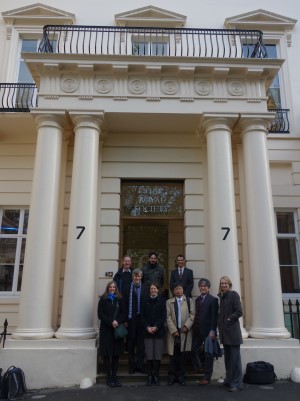 The "Suigetsu Varves 2006" project team received the prestigious Daiwa Adrian prize at a ceremony at the Royal Society. The prize is awarded every three years "in recognition of significant scientific collaboration between Japanese and British research teams in the field of pure or applied science".
Professor Hiroyuki Kitagawa (University of Nagoya) and Professor Takeshi Nakagawa (University of Newcastle), respectively representing the lead investigators in Japan and the UK, were presented with the award on behalf of the project team.
October 2012
The "Suigetsu Varves 2006" project has been in the news, with the release of our radiocarbon (14C) calibration dataset in the journal, Science (see: Bronk Ramsey et al. (2012), and also the accompanying 'Perspective' piece by Reimer (2012)).
Official press releases have been made from the contributing institutions:
Amongst other outlets, 'Suigetsu' is now on Wikipedia, both with its own dedicated page (wiki/Lake_Suigetsu), and discussed on the main radiocarbon dating page (wiki/Radiocarbon_dating).
Other mainstream science and popular science outlets have covered the publication of this dataset, including:
[English language]
- BBC World Service: "Science in action" (includes extended audio interview with lead author, Christopher Bronk Ramsey) (interview begins at 07:38 mins into the programme);
- BBC Radio 5: "Up all night" (discussion of Suigetsu begins at 2:44.45 hours into the programme);
- Chemical & Engineering News: "Range of radiocarbon dating gets a boost";
- Nature: "Core sample sends carbon clock farther back in time" (see also: "A more accurate carbon clock");
- New Scientist: "Muddy lake bed holds radiocarbon 'Rosetta stone'";
- Science: "New radiocarbon record may help refine ancient age estimates by hundreds of years" - including a link to a recording of the 17th October 2012 Science press teleconference, with comment from 4 of the paper's co-authors. (See also: "Dating carbon" and: "Record from Japanese lake improves radiocarbon dating".);
- Scientific American: "Carbon dating gets a reset";
- Smithsonian.com: "A new leap forward for radiocarbon dating";
- The Scientist: "Refining radiocarbon dating";
- Voice of America: "Lake sediment could better date ancient finds" (includes audio clip of interview with lead author, Christopher Bronk Ramsey);
- about.com: "Radiocarbon calibration news";
- Αρχαιολογία Online (Greece): "Scientists advance new method of radiocarbon dating";
- Asian Scientist: "Japan’s Lake Suigetsu provides 52,800-yr archaeological clock";
- Before It's News: "Muddy Japanese lake offers spectacular prospects for carbon dating";
- Business Insider: "The most important records for dating old objects were just found in a Japanese lake";
- Current World Archaeology: "Japanese time capsule extends radiocarbon dating 40,000 years";
- Discover Magazine: "At the bottom of a Japanese lake, the key to more accurate carbon-dating";
- E! Science News: "'Time-capsule' Japanese lake sediment advances radiocarbon dating for older objects";
- French Tribune: "Sediments of Lake Suigetsu to help researchers measuring carbon dating";
- Glasgow City of Science: "Sharpening the focus of radiocarbon dating";
- Heritage Daily: "‘Time-capsule’ Japanese lake sediment advances radiocarbon dating for older objects";
- IEEE Spectrum: "Japanese lake provides more definitive record of carbon-14 levels ";
- Latinos Post: "New carbon-dating metric discovered at the bottom of a Japanese lake";
- Los Angeles Times: "50,000-year-old sediment from Japanese lake improves carbon dating";
- messagetoeagle.com: "Carbon clock sheds light on the greatest archaeological mysteries";
- Phys.org: "'Time-capsule' Japanese lake sediment will improve radiocarbon dating";
- planetsave.com: "Radiocarbon dating accuracy will greatly improve thanks to discovery of ‘perfect’ sediment cores in Japanese lake";
- Popular Archaeology: "Scientists advance new method of radiocarbon dating";
- Popular Science: "This mud could revolutionize how scientists study the past";
- Quest (Northern California, USA): "A new radiocarbon yardstick from Japan";
- Red Orbit: "Radiocarbon dating improved with sediment measurements";
- Science Codex: "Japanese lake record improves radiocarbon dating";
- Science Daily: "'Time-capsule' Japanese lake sediment advances radiocarbon dating for older objects";
- science-news.eu: "Japanese lake provides more definitive record of carbon-14 levels";
- Science Newsline: "Japanese lake record improves radiocarbon dating";
- Terra Daily: "Japanese lake record improves radiocarbon dating";
- TG Daily: "Lake mud offers secret of more precise carbon dating";
- The Asahi Shimbun: "Scientists: Lake Suigetsu sediment precise archaeological clock";
- The Bell Jar: "Muddy lake bed in Japan holds radiocarbon ‘Rosetta stone’";
- The Japan Daily Press: "New advancement for carbon dating found in Japanese lake";
- The Journal (North-East England, UK): "Newcastle University experts uncover more accurate radiocarbon dating";
- The News Today (Bangladesh): "Radiocarbon dating improved with sediment measurements";
- The Oxford Student: "New carbon dating method discovered";
- Wales Online: "Carbon dating can now stretch back 54,000 years thanks to Welsh scientists";
- ZME Science: "Muddy Japanese lake offers spectacular prospects for carbon dating";
[Japanese language]
[German language]
[Russian language]
[Dutch language]
[Finnish language]
[Flemish language]
[French language]
[Italian language]
[Polish language]
[Portuguese language]
[Spanish language]
[Swedish language]